Your first ten hours in No Man's Sky
Mode choice, Sodium and Oxygen, Pulse Engine repair, visor money, and a first base — without marrying the starter hull.
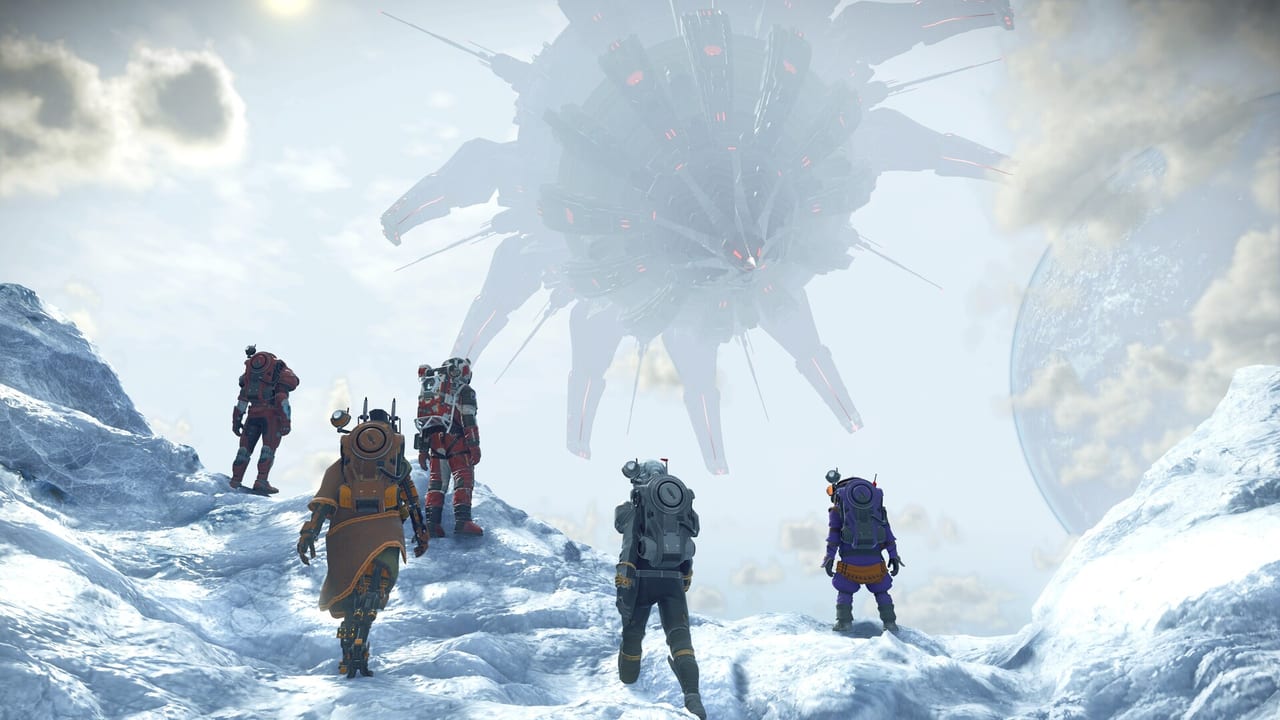
You wake up beside a wrecked starship on a random world. Hazard protection ticks down. Life support ticks down. The mining beam overheats. That panic is the tutorial, not the whole game. No Man’s Sky released on 12 August 2016, and Cosmos 7.0 (9 September 2026) still starts the same way: survive the crash, repair the Pulse Engine, and leave. This page is the first ten hours for a new or returning Traveller. It assumes you want a long save, not a Creative sandbox and not a Permadeath horror run.
If buttons feel hostile, park this tab next to Controls. If you already have a warp-capable ship and you are here for money, skip to Units and Nanites. Everyone else should stay in order.
Pick Normal, then forget the other labels
Character creation is cosmetic. Mode choice is not. Normal is the recommended first save: survival meters exist, death drops a grave, and the universe is fully populated. Creative removes the grind so you can screenshot architecture. Survival and Permadeath tighten drains and stack sizes; Permadeath deletes the save on a true death. Abandoned empties stations and story NPCs so the galaxy feels post-collapse and pushes you toward Autophage-style salvage.
You can later customise individual sliders, but do not start by turning every penalty off and then wondering why the game feels empty. Keep tutorials on. Keep starting slots standard. If a planet is extreme — perpetual storms, five-second hazard bars — repair the ship and leave. The first world is a seed, not a forever home.
Scanner, Sodium, Oxygen, Ferrite
The first repair is the scanner. Mine small rocks for Ferrite Dust, then spend it in the Multi-Tool inventory. Without a scanner you are blind. With it, a tap highlights Sodium (yellow plants, hazard protection), Oxygen (red plants and hazardous flora, life support), Carbon (plants and trees, mining-beam fuel), Di-hydrogen (blue crystals, launch fuel), Copper (stellar metal for Chromatic Metal), and Cobalt (caves, ion batteries).
Keep a stack of Sodium and Oxygen in the Exosuit at all times. Recharge from the inventory or, faster, from the Quick Menu without opening the full grid. Punch plants with melee if the mining beam is empty — it yields Carbon so you can refuel the beam. Caves block storms. If a sentinel notices you, either finish the rock and walk away or be ready for a fight you do not yet want.
Repair the Pulse Engine, then actually leave
The wrecked ship has a broken Launch Thruster and Pulse Engine. Follow the on-screen mission. You will craft a Metal Plate from Ferrite Dust, hunt a Hermetic Seal (or the materials the tutorial substitutes), and build Di-hydrogen Jelly for the thruster. Craft a Portable Refiner from a Metal Plate plus Oxygen so you can turn Ferrite Dust into Pure Ferrite and Copper into Chromatic Metal. That refiner is the first industrial habit worth keeping.
Once both systems are green, sit in the ship until hazard protection fills, take off, and pulse toward the space station in the same system. Do not spend two hours decorating a tin can on the dirt. The station sells maps, upgrades, and a scrap vendor. The Ships and Corvettes guide explains why your starter C-class hull is a taxi, not a project.
Analysis Visor: the real tutorial
Hold the Analysis Visor and scan every unknown plant, creature, and mineral. Each discovery pays Units. A complete fauna set on a planet pays Nanites. This is the honest early economy. You do not need a chlorine farm on day one. You need the visor on your mouse button or trigger until scanning is a reflex. Later, S-class scanner modules multiply those payouts so hard that a pretty planet becomes a bank. That upgrade path is the whole point of the units and nanites page; here you only need the habit.
Upload discoveries from the pause menu so the Nanite drip actually lands. Talk to the station vendor of the local race — Gek, Korvax, or Vy’keen — and buy a language word or two. Standing is cheap this early and it unlocks better dialogue at monoliths.
Do not dump hours on the first C-class ship
Crashed ships light up on the visor and on planetary charts. Claiming one feels like a jackpot. It is not. A crashed C-class Fighter with broken slots costs more time to repair than it is worth. Claim it if you want the scrap: fly it to a station, sell the hull, and recycle the installed modules into Nanites. Then go back to the starter ship or a cheap Shuttle until you can fund something with a role — a Solar for cheap pulsing, a Hauler for cargo, or, after Voyagers 6.0, a Corvette you actually walk around inside.
The same rule applies to Multi-Tools. The first cabinet on a station is a lottery ticket. Buy it only if the class and slot count are obviously better. Spend Nanites on scanner modules before you spend them on a class upgrade for a tool you will replace.
Space Anomaly, first base, Artemis Path
The story will introduce the Space Anomaly. Summon it from the Quick Menu once that option appears. The Anomaly is the real hub: Nada and Polo, Iteration vendors for Exosuit and Multi-Tool blueprints, the Nexus for multiplayer missions, and the Expedition terminus for Expeditions. Buy Exosuit cargo slots from the station vendor every time you dock — that is a better first purchase than a paint job.
Place a Base Computer on a mild planet, claim the site, and drop a Save Point plus a teleporter once you have power. The base-building guide covers solar panels, batteries, and the industrial layer. Your first base only needs to be a waypoint you can warp back to. Do not start a mega-build until the Hyperdrive is fuelled and you have visited two or three biomes.
The Artemis Path is the through-line that teaches warping, the Anomaly, and eventually portal glyphs. Sixteen glyphs exist. Portal addresses use twelve. Travellers who sit on space-station benches will sell a grave location for 100 Nanites; those graves teach glyphs. Monoliths, once you know enough of the local language, can point you at a portal. The portal glyph primer is the reference; this guide only asks you not to ignore Artemis just because the side content looks shinier.
A ten-hour checklist that actually finishes
By hour ten you want: a repaired Pulse Engine, a Hyperdrive with Warp Cells, a Base Computer you can teleport to, a stack of Sodium, Oxygen, Ferrite Dust, Carbon, Di-hydrogen, Copper, and Cobalt, a few Exosuit slots, and at least one visit to the Anomaly. You do not need a completed Corvette, an orbital station, or a Stasis Device factory. Cosmos 7.0 added a star system map, hulks, outposts, bio-wrecks, asteroid belts, and player-owned stations — all of that waits until you can recharge the suit without thinking.
If the first planet is ugly, leave. If a storm starts, cave. If pirates scan you, boost toward the station. If you find a sentinel Interceptor signal, bookmark it and come back with better shields. The resource list is there when a recipe name does not match the rock in front of you. The Guides Hub is the map when this page has done its job.
The first ten hours are a filter. Players who treat the wreck as a homestead stall. Players who treat it as a launch pad start seeing the joke Hello Games has been telling since 2016: the galaxy is enormous on purpose, and the skill is deciding what not to finish. Repair the engine. Scan the flowers. Scrap the junker. Put a computer in the dirt. Then go find a star that is not the one you spawned under.
Frequently Asked Questions
Quick answers Travellers search for after Cosmos.
Which game mode should a new player choose?
Normal. Creative is for building without meters. Survival and Permadeath punish inventory and death. Abandoned removes most NPCs. You can customise sliders later; start on Normal so the beginner loop still teaches survival.
What resources do I grab in the first hour?
Sodium for hazard protection, Oxygen for life support, Ferrite Dust for repairs, Carbon for the mining beam, Di-hydrogen for launch fuel, then Copper and Cobalt as you expand. The resource list has the longer table.
Should I repair every crashed ship I find?
No. Claim it, scrap it at a station for Units and Nanites, and wait for a hull with a role. See Ships and Corvettes and the ship tier list.
When do I unlock portal glyphs?
Follow the Artemis Path and pay Travellers on stations 100 Nanites to mark graves. There are 16 glyphs; addresses use 12. Monoliths locate portals. Full reference: portal glyphs.
Is the Space Anomaly required?
Yes, if you want blueprints, Nexus missions, and expeditions. Summon it from the Quick Menu after the story introduces it. It is also the lobby for multiplayer.
Does Cosmos 7.0 change the opening hour?
Not the crash site. Cosmos overhauls space once you can fly — star map, hulks, orbital bases, owned stations. Read Cosmos after you can warp, not before you have Sodium.